So Is He God, the Devil, or Simply Human?
Refn serves as writer on Only God Forgives as he does on most of his films — with the notable exception of Drive (2011), the film that sky-rocketed Ryan Gosling's career. This is a different kind of Gosling vehicle: quieter, stranger, and considerably more demanding.
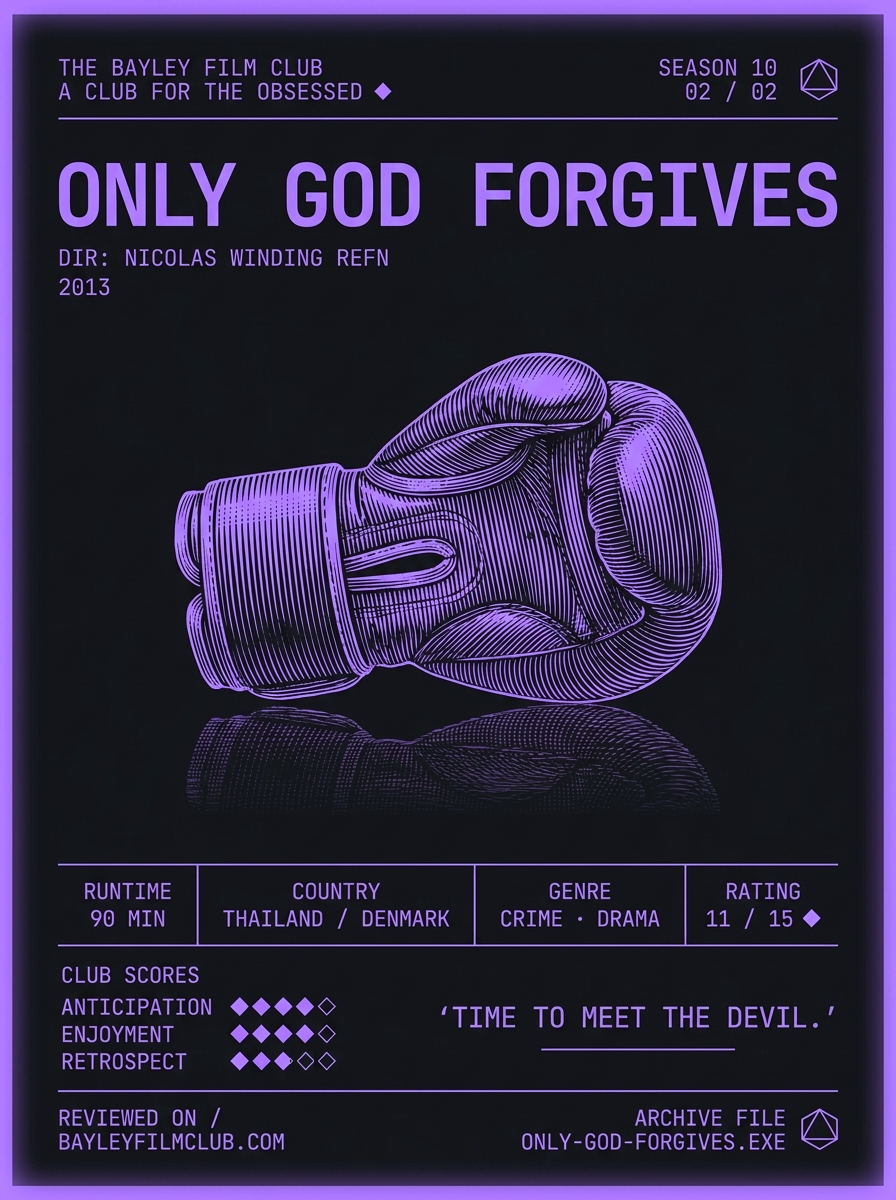
The story is built around Julian Thompson (Ryan Gosling), a boxing club owner by day and a respected figure of the criminal underworld who runs a drug-dealing empire by night. The unexpected death of his brother Billy sets in motion a chain of events whose consequences cause suffering for every character involved — in some cases the highest price of all.
The film is very artistic and full of symbolism. Beautiful scene settings and transitions with sound and light effects make a strong impression and bind the motifs together. In fact, sound and light seem to play a more critical role than the characters or the script itself — Gosling speaks only seventeen lines throughout the entire film. The leading forces are morality, guilt, punishment, and revenge.
The role of the devil is to bring justice upon those who disobey — and it is carried by a police officer. Lt Chang gets everywhere on foot and seems gifted with a sixth sense, acting with a strong belief in his own judgement, practically in a god-like manner.
It is made clear, however, that Chang is just a man — with a home and a family to look after. So is he a god, the devil, or simply human with a god complex? We see him primarily bringing justice: punishing those he decides to, in ways he sees fit. We never witness his forgiveness — which, according to the title, disqualifies him from being God. In fact, the only character who shows mercy to anyone is Julian.
There are two recurring metaphors in the film. The first is doors — a link to passing away, and therefore to judgement and the ever-present dilemma between good and evil. The second is hands, including the washing of hands as a symbol of removing guilt or acting in a higher purpose. Both motifs are strongly connected to the storyline and, with attention, self-explanatory.
Near the end, Julian puts his hand into his dead mother's womb. For some time I couldn't wrap my head around it — until I read that the idea came from Gosling himself. No need to link it anymore, I suppose.
Only God Forgives is not an obvious film. It requires open-mindedness and constant focus, and even then it can still be confusing. Refn is juggling symbols to pass a message, and without concentration, afterthought, and genuine consideration — it is hard to appreciate. That is reflected in the relatively low IMDB score of 5.7. The question is really how much of a mental challenge you expect from a film. If you are in the mood for something easy, better put on Lethal Weapon for the nth time rather than reaching for this, because you will only get annoyed. And I really think this film deserves a fair chance.

As an Amazon Associate I earn from qualifying purchases.