Madness as Art
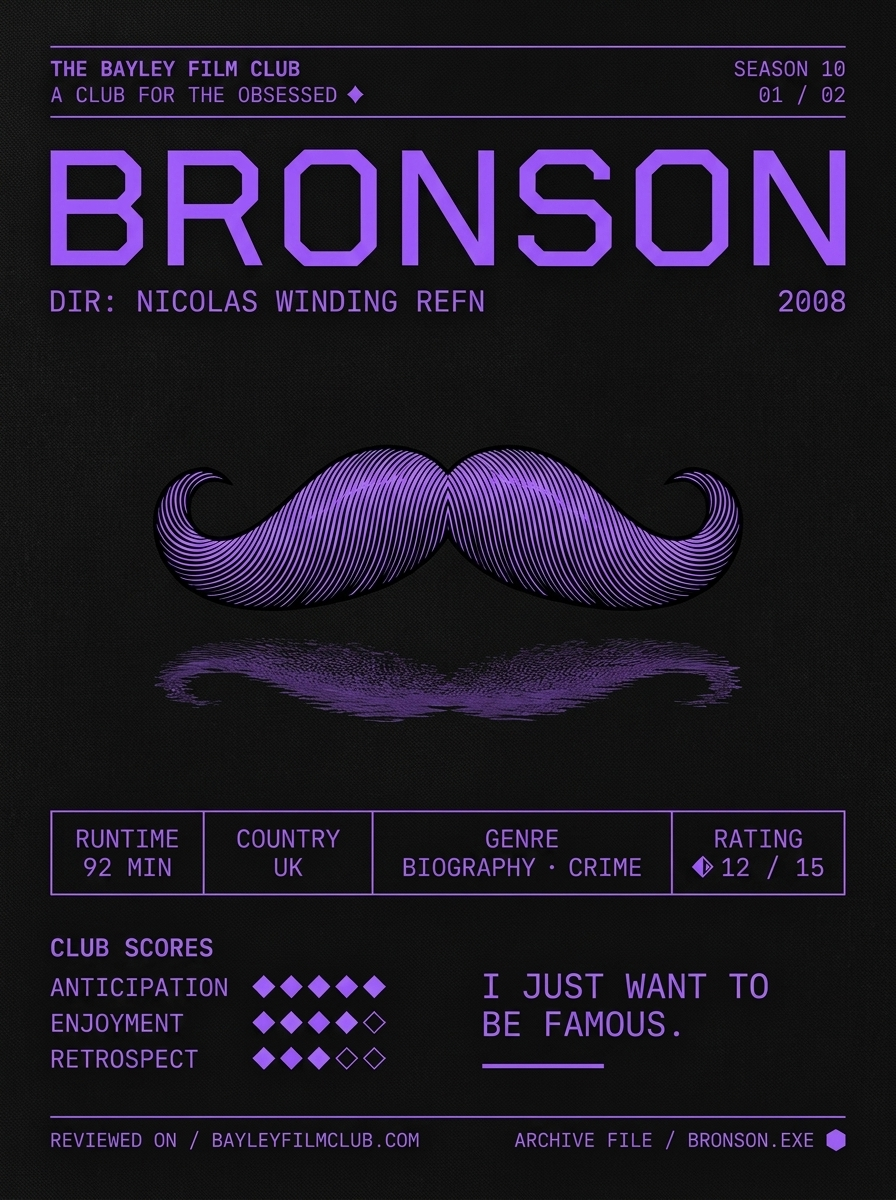
The best thing about Bronson is the story. Charles Bronson — born Michael Peterson — is one of the most famous British prisoners, and he became so because of his extreme violence. The role was given to Tom Hardy, who handled it with perfection. That doesn't come as a surprise. What does surprise is how Refn frames the whole enterprise: not as a cautionary tale, not as a character study in the conventional sense, but as something closer to a performance piece about a man who chose madness as his medium.
This film is about madness, the risks of isolation, and violence — in an interchanging and continuously colliding order. Refn shot it in a thoughtful way, presenting Bronson's madness not as a symptom but as an art form — a consciously chosen path — and Bronson himself as the artist. In many scenes, lights, angles, music, and perspective are deployed with real consideration. This approach to filmmaking with an artistic twist is something I admire a great deal in Refn's work, and it is fully present here.
The film is also structured around a theatrical conceit — Bronson narrating his own story to an imagined audience, performing himself — which gives Hardy extraordinary licence and which he exploits completely. It is a big, physical, committed performance that never tips into parody, which is a difficult line to hold.
Bronson is following some kind of logic in his behaviour. But is that enough to be claimed suitable for becoming part of society again?
Bronson also opens a discussion about mental illness within prison walls, raising questions that troubled me throughout: is there enough room for sanity in that environment? And how do you recognise someone losing it? Charlie Bronson follows a coherent internal logic — which makes him simultaneously comprehensible and terrifying. Whether that logic constitutes a basis for rehabilitation, or whether it simply makes him a more articulate kind of dangerous, is a question the film poses without answering.
I suppose you need to watch it and make up your mind individually.