Who Are You to Decide?
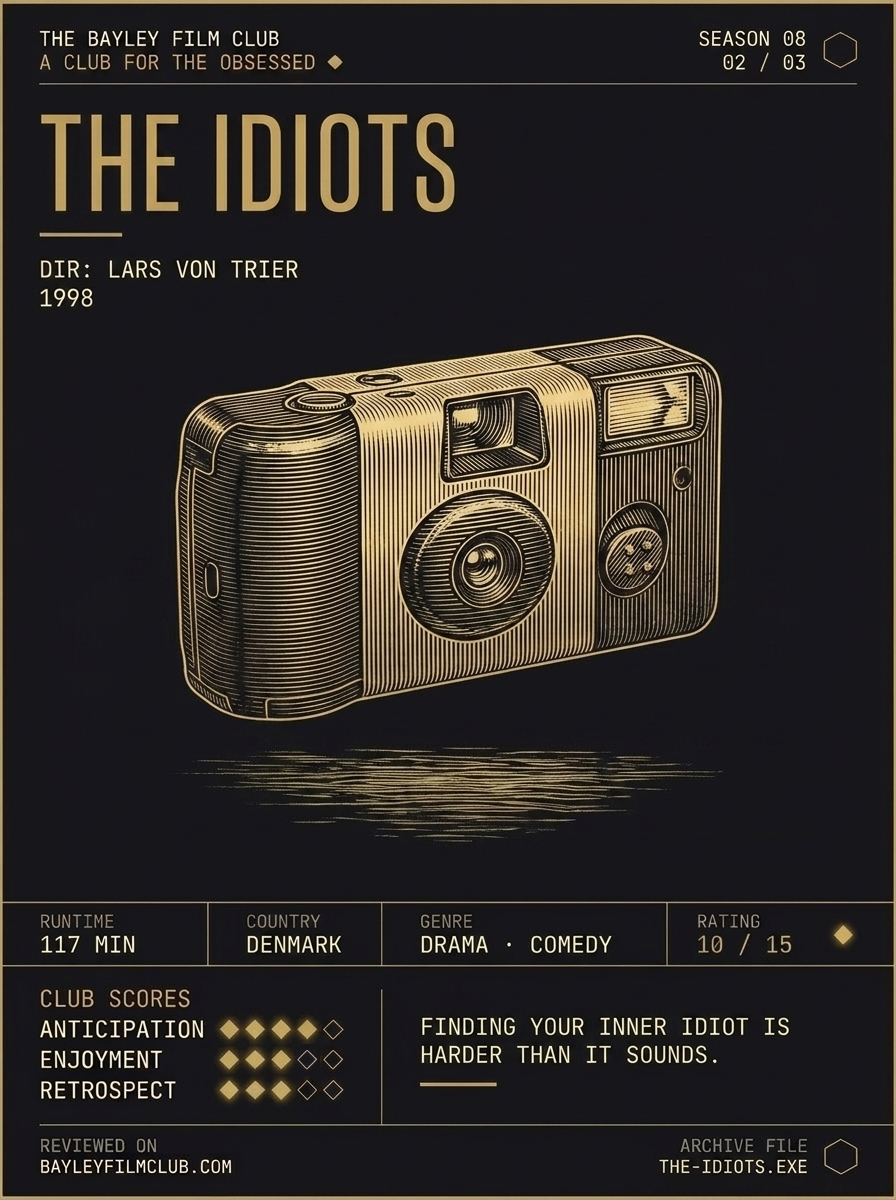
The Idiots is the second film from the Golden Heart Trilogy. We meet a group of people who pretend to be mentally disabled — for fun. The idea itself is something most would consider ethically unacceptable. Von Trier knows this. He is counting on it.
The story begins when the group welcomes a new member — Karen (Bodil Jørgensen) — who runs into them by chance during one of their performances. Karen seems frightened and distant, but she stays, drawn to the company of people who appear not to care about social boundaries, who don't judge or ask questions. We find out later why this particular setup suited Karen so perfectly.
At first the group appeared to me as a collection of people without purpose who had simply chosen a very unusual way of spending their time. But we soon realise these are intelligent human beings — some of them leading successful careers — who are nonetheless pursuing the idea of finding their inner idiot. Their leader, Stoffer (Jens Albinus), begins pushing the others harder, claiming they are not trying hard enough, not taking the matter seriously enough. The irony is painful. Stoffer's anger, we understand, is driven by jealousy: he is the only one with no other reality to return to when the performance ends. While the others have careers, families, responsibilities — anything worth coming back to — Stoffer has only this.
Eventually the group falls apart and they never see each other again. Von Trier leaves you with no available weapons to judge any of them. Almost as if he's asking: who are you to decide?
The last scenes unravel the specifics of Karen's situation and reframe the entire narrative. Von Trier appears to be trying to leave the viewer without the tools to pass judgement on his characters — which is itself a kind of provocation.
The film opens a discussion about disability and forces the viewer to honestly reconsider their own feelings, attitudes, and behaviour. Do I treat disabled people as genuine equals? Do I feel uncomfortable around them, and if so, why? Would I object to living next door to an institution for the disadvantaged? These are not comfortable questions. Von Trier does not make them comfortable.
Secondarily — and perhaps more universally — the film is about freedom, madness, and coping with life and its tragedies. Something we all must manage, and as many people as there are, there are as many coping mechanisms. Who has the authority to say which are acceptable and which are not?
The film forces you to ask: do I treat disabled people as equals, really? Do I feel uncomfortable around them — and if so, why exactly?