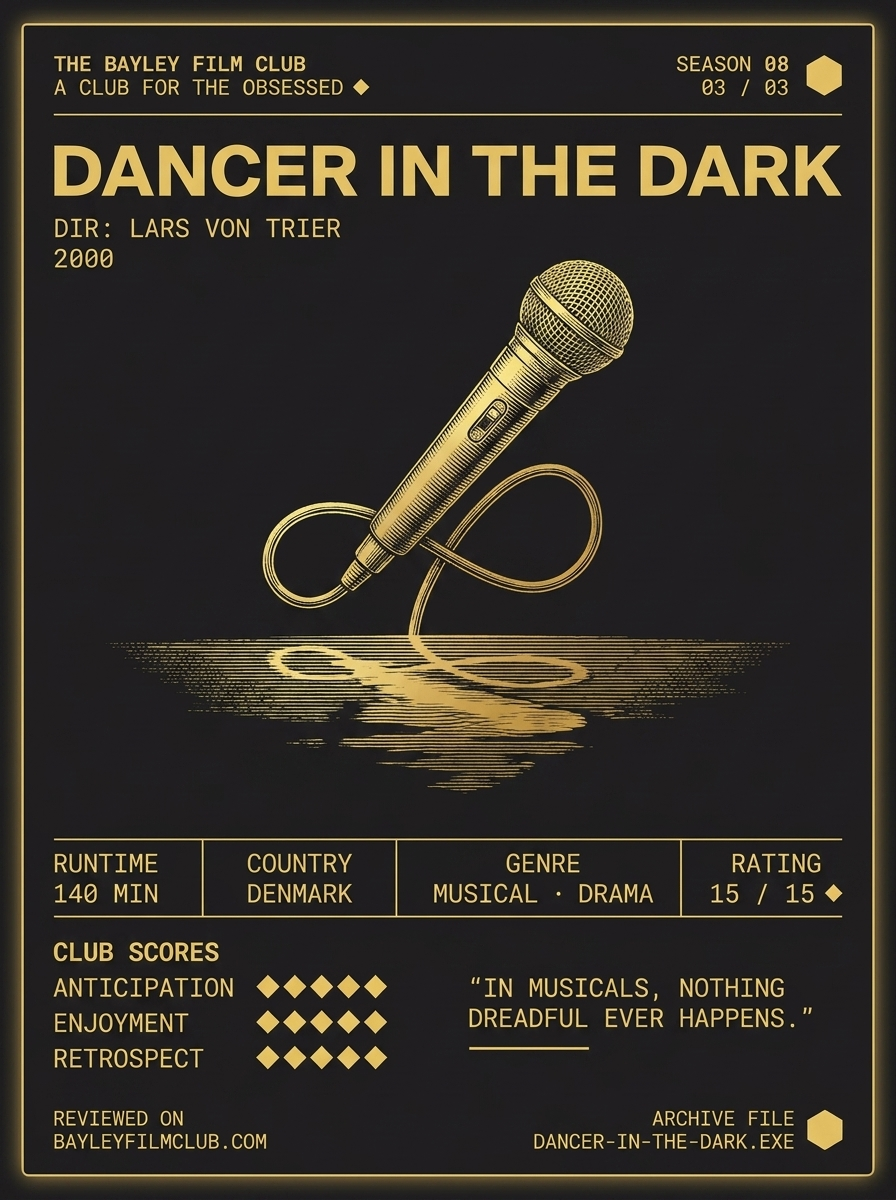
In Musicals, Nothing Dreadful Ever Happens
Dear reader — Dancer in the Dark is the best one. Out of the trilogy and possibly out of Lars von Trier's entire filmography. It sits comfortably in my personal top five of all time, and it wins without contest the title of the saddest film I have ever seen. The Palme d'Or in 2000 was well deserved. So was the Best Actress award for Björk.
The film tells the story of Selma (Björk), a young woman who has emigrated to America with her son. Selma is suffering from rapidly deteriorating eyesight that will eventually lead to blindness. Living the simple life of a factory worker whose passion is music, she is saving every penny for her son's eye operation — he carries the same condition, and her primary goal, above everything else, is to spare him from her fate. Anything else is secondary.
We could say that Selma makes one large mistake: trusting the wrong person. After this happens, we watch the story slowly tighten around her — metaphorically and literally. As is characteristic of von Trier, we witness how people drag themselves into a spiral of poor decisions that quickly leaves them with no choice but to keep going deeper and deeper toward the inevitable.
Music makes Selma joyful and pure like a child. It helps her get through the routine of every day and any obstacle. Music, in the end, saves her — in the only way it can.
On screen you may recognise faces from earlier in the trilogy — Stellan Skarsgård, Jean-Marc Barr, Jens Albinus — alongside bigger names: Catherine Deneuve, Peter Stormare, David Morse. All give impressive performances. But most importantly, Björk — who is absolutely extraordinary in every scene, in every song, in every terrible moment the film places her in.
Music plays an essential role in Dancer in the Dark. It binds the story, gives it rhythm, and adds a dimension that no amount of dialogue could. The musical numbers are not escapism — they are survival. They are how Selma processes a world that keeps closing in on her. Love for music makes her joyful and pure like a child. It helps her endure the routine of everyday life and whatever obstacles arrive. Music, in the end, saves her.
"In musicals, nothing dreadful ever happens." Selma says this and believes it completely. Von Trier has other plans.
Dancer in the Dark is a musical in which something dreadful happens. Von Trier takes the most innocent and optimistic of all film forms and uses it to construct one of the most merciless tragedies in modern cinema. By the end, the contrast between the joy of the musical numbers and the horror of what surrounds them becomes almost unbearable. Almost. You stay, because Selma stays. You endure, because she endures. And when it is over, you sit with it for a very long time.
As an Amazon Associate I earn from qualifying purchases.