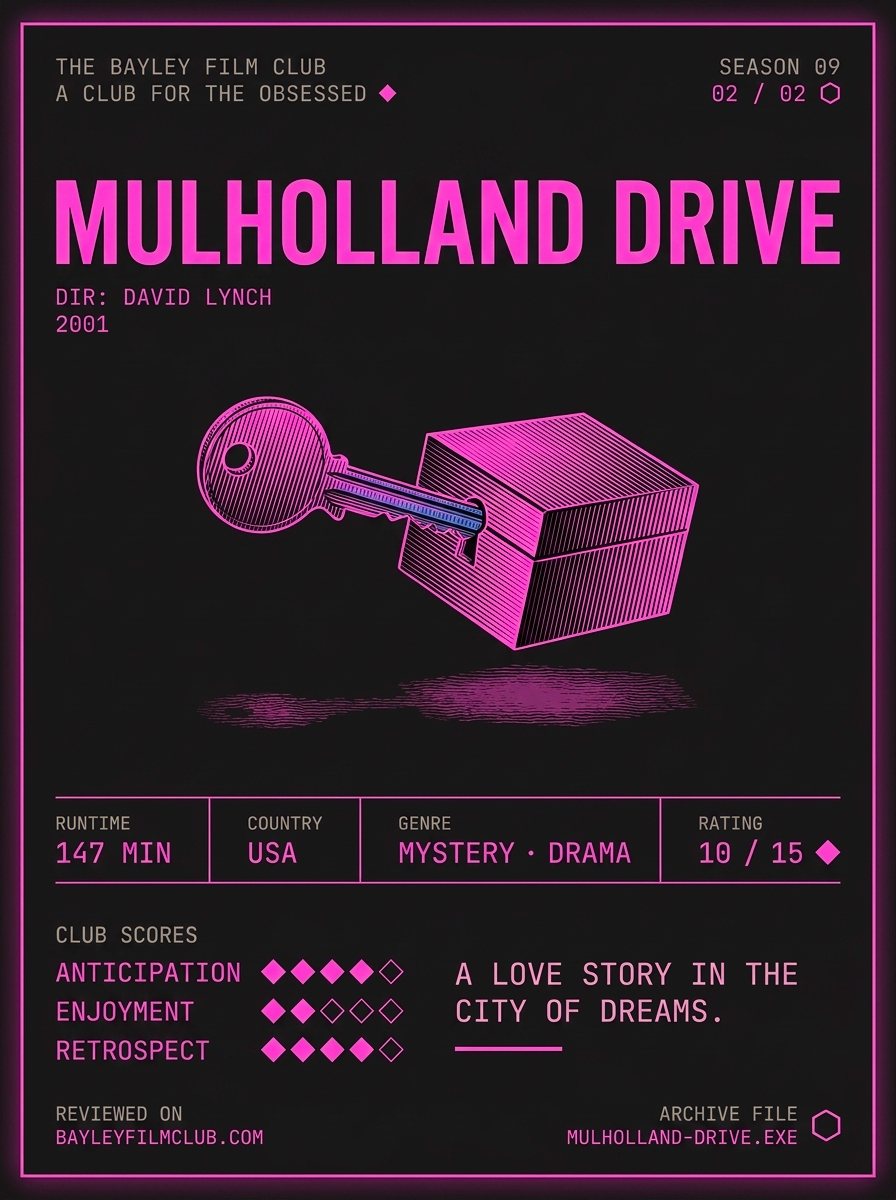
What Is Real?
Mulholland Drive keeps you feeling uncomfortable. In very David Lynch fashion, both the story and the camera move slowly, building tension. Shots are framed at unfavourable angles. Conversations make you queasy. This lasts a fair while — I would say all the way to about 80% of the film. At that point I was beginning to think that either I was too daft to understand the symbolism, or it simply didn't make any sense whatsoever, and my attempts to give meaning to a madhouse with more plot holes than Swiss cheese were just a waste of time.
Then comes stage two — roughly the next fifteen percent. I recall turning to my partner and asking: do you understand what is going on? If the first section was confusing, it was merely a foreword to what we encounter here. Everything unravels further, the ground shifts again, and Lynch gives you nothing to hold onto.
Stage three is where it all slowly comes together, and Lynch finally allows us to connect the dots. The plot holes you had been catching throughout? They were there for a very good reason. The built-up frustration releases with the next few breaths and relief settles in. That was a close one.
Naomi Watts is absolutely phenomenal. I am buying everything she is selling, and I am doing it with immense pleasure.
Although the film is genuinely not an easy watch, figuring it out at the end and processing it afterwards got my brain working like it was on steroids. I had to start writing the review immediately. Lynch has masterfully portrayed the reality of a fantasy — the workings of our brains, human motivation, and the particular way that obsession rewrites everything around it.
I particularly appreciated how familiar parts of Diane's life were woven into the dream logic of the story. If she considered someone unimportant, their appearance in the fantasy introduced fewer details — the action mirrored exactly where her interest was focusing. Very clever. Diane was obsessed. She needed to feel in control, to be seen and admired. So she made it so. Nothing is impossible when you're lying — including to yourself.
Betty was so fearless. Naive, yes. Too trustworthy, yes. But jumping head-first into a clearly dangerous situation without hesitation. If you have ever experienced lucid dreaming, you will know — nothing bad can ever happen when you are in control.
There is an overwhelming amount of symbolism in this film, and honestly, much of it felt a little vague and to me unnecessary. The blue box — I get it. The scary homeless man behind the diner? I found that blurry and distracting rather than illuminating. But being over the top is Lynch's signature move, and we shouldn't be too surprised.
The film delivers. A cocktail of fantasy and real life, mixed with an unhealthy dose of jealousy and infatuation, wrapped in a rotting Hollywood vibe. That is how I would describe Mulholland Drive — and that description, I think, is exactly what Lynch intended.
As an Amazon Associate I earn from qualifying purchases.