There's Trouble Until the Robins Come
Compared to Mulholland Drive, Blue Velvet is straightforward. That is not a criticism — it is simply an observation about where this film sits in Lynch's body of work. There is no fractured timeline, no dream logic pulling the floor away from under you. What we have is a clean, linear good-versus-evil story told with all of Lynch's visual instincts fully intact. Whether that is enough depends on what you came for.
The film opens with a sequence of almost aggressive normality — white picket fences, red roses, a man watering his garden. Lynch lingers on it just long enough to make it feel wrong. Then the camera descends below the surface of the grass, into the soil, into the insects writhing underneath — and you understand immediately that this is not a story about the surface of things. That opening shot sets the entire film's agenda, and I did not fully appreciate it at the time, as I was finishing my dinner. In retrospect, a well-timed viewing choice it was not.
What follows traces this insect logic throughout. Jeffrey (Kyle MacLachlan) poses as a bug exterminator to gain access to Dorothy's apartment — a detail that is not accidental — and the film ends on a robin eating a bug in a sunlit window. There is trouble until the robins come. Lynch builds his symbolism in plain sight and trusts you to notice it, which I appreciate, even when the story underneath the symbols is, as here, relatively thin.
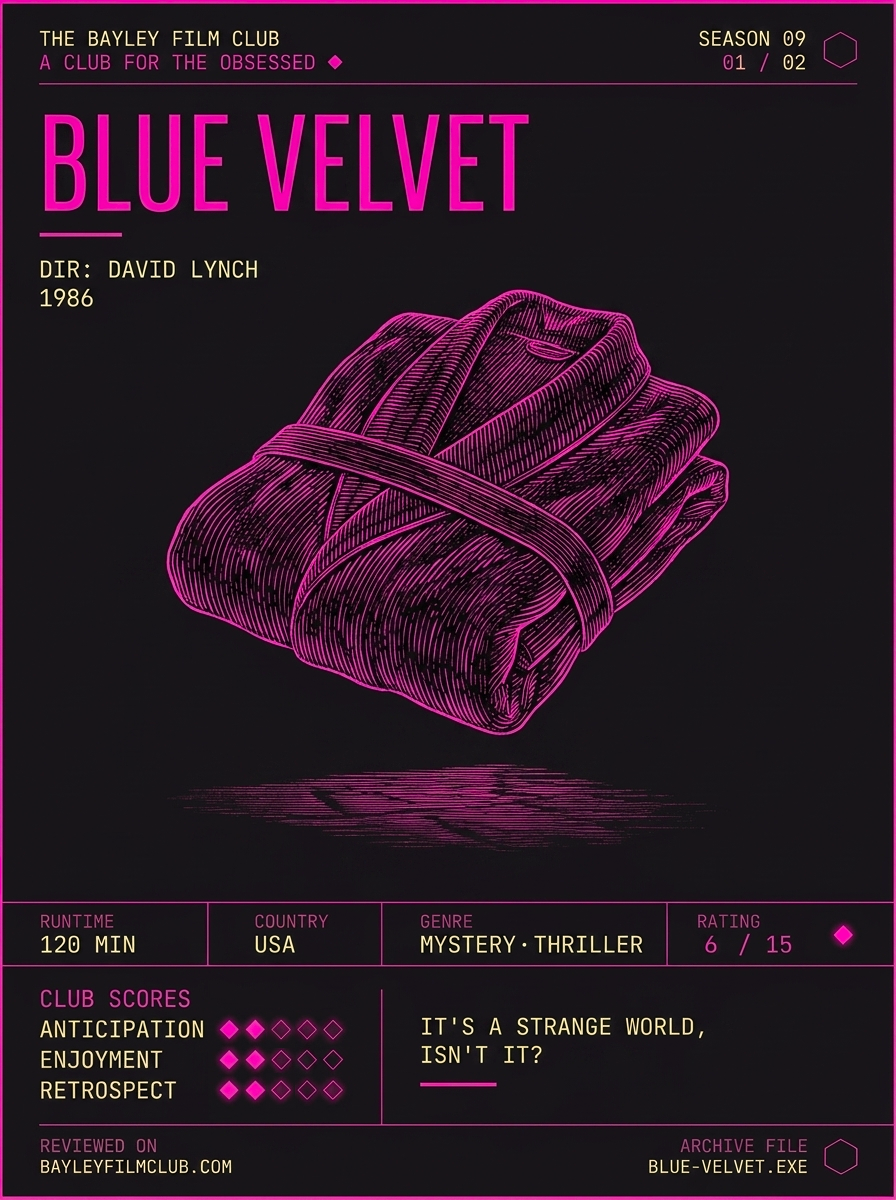
The blue velvet and the red curtains remind me of arteries — of a beating heart. This seemingly perfect small town, connecting to its evil underbelly where crime, violence and cruelty reign.
The use of colour is one of the film's genuine pleasures. Red and blue appear with deliberate clarity against an otherwise overwhelmingly bland palette — the kind of muted, washed-out suburban tones that Lynch uses to suggest a world drained of life. Against all that beige, a red rose or a blue piece of fabric carries real weight. I found myself thinking about what those colours were doing there — which felt like exactly the right response to have. The velvet of the title and the red curtains feel almost anatomical — like the lining of something living, the soft interior walls of a town that presents a clean face to the world while something else entirely pulses underneath.
Laura Dern is wonderful here. Sandy is clearly positioned as the film's moral centre — the good to Frank Booth's evil — and if that wasn't already evident from her general presence and warmth, it becomes unmistakable when she shares her dream with Jeffrey. The robins carrying light in their mouths. It is a beautiful and slightly absurd moment, and Dern plays it with complete sincerity, which is the only way it could possibly work.
Frank Booth gives me the creeps — completely and deliberately. Dennis Hopper plays him with a kind of unhinged commitment that makes every scene he's in genuinely uncomfortable to sit through.
Dennis Hopper as Frank Booth is the film's most memorable element by some distance. He gives me the creeps — fully and intentionally — and that is a significant achievement. There is something genuinely unpredictable about him that keeps every scene he occupies on edge. The film also surprised me in places I wasn't expecting to be surprised, which I always appreciate. I had assumed I knew roughly where things were going, and Lynch reminded me that he's behind the wheel.
I was less convinced by Kyle MacLachlan as Jeffrey. He kept me at a slight distance throughout — something about the performance that I couldn't entirely invest in, which is a problem when you are spending two hours in someone's company.
I did enjoy the structural decision to mirror the opening and closing sequences — the same images, the same suburban perfection, bookending the darkness in between. It gives the film a cohesion that the middle section sometimes lacks, and it lands the insect symbolism with satisfying finality. It also raises the question of whether anything has really changed — whether Jeffrey's journey underneath the surface of Lumberton has altered anything, or whether the picket fences simply close back over it.
I also hadn't realised until now that this film is likely the origin of the line: "That's for me to know and for you to find out." Jeffrey delivers it to Sandy when she asks whether he is a detective or a creep — and it lands with just enough charm to be funny and just enough evasion to be unsettling. Forty years later it is still in circulation. That is a kind of legacy.