The Best Scenarios Are Written by Life
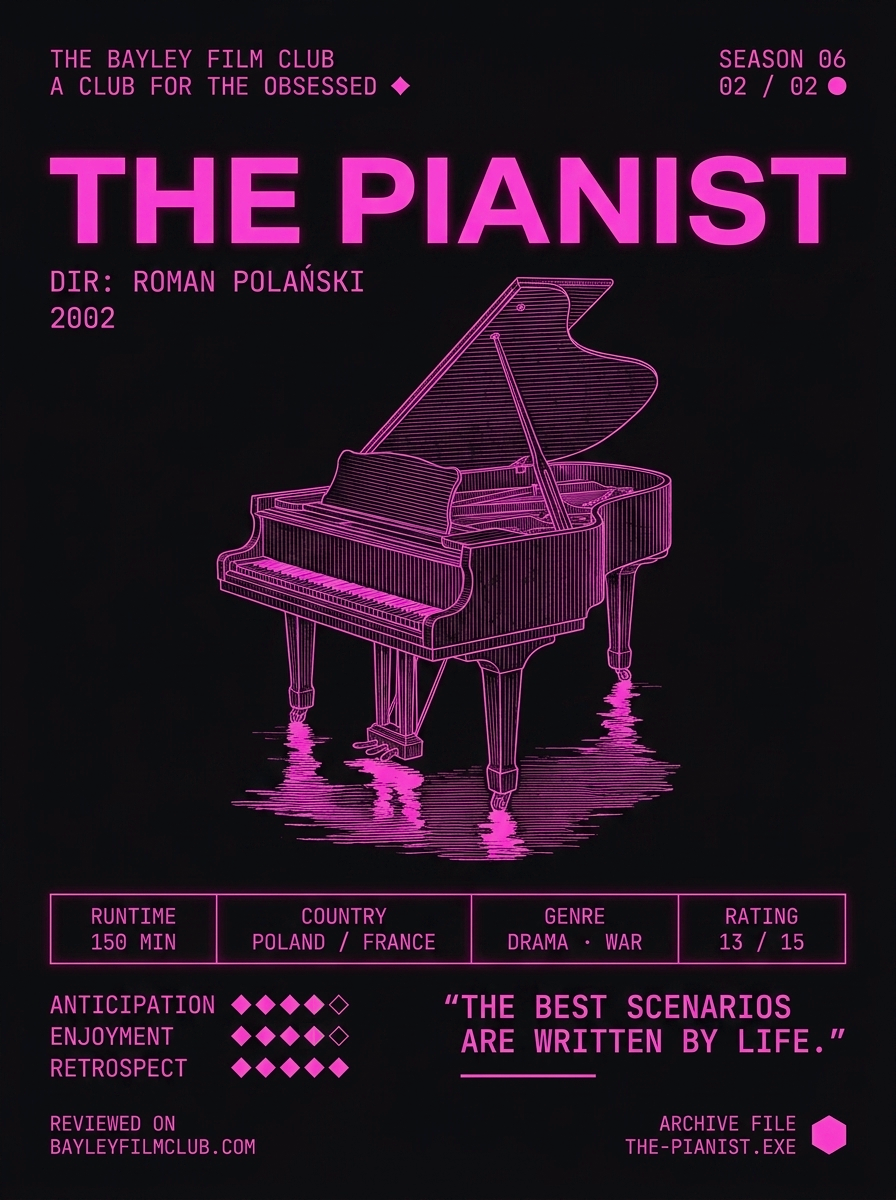
For me, as a Pole, The Pianist is not just another historic film. It is a story that moves me deeply and carries a lot of meaning — a story so easily interpreted and beautiful that it becomes personal. Roman Polański finds a remarkable balance between the hard-to-watch extermination of Jews during the Second World War and the delicate beauty of music. The film follows the life of Władysław Szpilman during his years in German-occupied Warsaw: a story of severe pain, hunger, unimaginable suffering, and the near-total absence of humanity. But here and there, it offers crumbs of hope and sheer luck. This was the third time I had watched it. I always look forward to it.
The music in the film includes the finest works of great composers — starting with Chopin, moving through Beethoven and Bach — alongside original pieces by Wojciech Kilar, the internationally recognised Polish classical and film music composer. There is no doubt that these brilliant pieces, and the love of music itself, helped Szpilman survive the horrors of the occupation and saved him from losing his sanity entirely. Polański understands this and lets the music speak without commentary or sentimentality.
The most important message I take from The Pianist is that we should never generalise people. Not all Germans during the war were cruel sadists or ruthless killers. Not all Poles were good Christians who would give their last piece of bread to share with another. The film is populated with characters who represent the opposite of their stereotype, and two of them are worth singling out.
A young Polish man gathered funds in the name of Szpilman across the city — but used the money not to buy food, instead spending it on himself, leaving the famous pianist to starve.
On the other side: a German officer — Wilm Hosenfeld — who found Władysław hiding among the ruins of Warsaw. He did not kill him. He arranged a German command centre in the same building so that he could bring food without raising suspicion, because the darkest place is always under the candlestick. And when the Russians were approaching from the other side of the Vistula, he gave Szpilman his own coat before leaving.
Two men. Neither behaving as their nationality would have predicted. That is the film's quiet, devastating argument — and it is delivered not through dialogue or proclamation but simply by showing what happened. The Pianist is a true story, and with it, Roman Polański proves that the best scenarios are written by life.
The darkest place is always under the candlestick. Polański knows this — and so did Wilm Hosenfeld.