Not Like Hollywood Pictured It
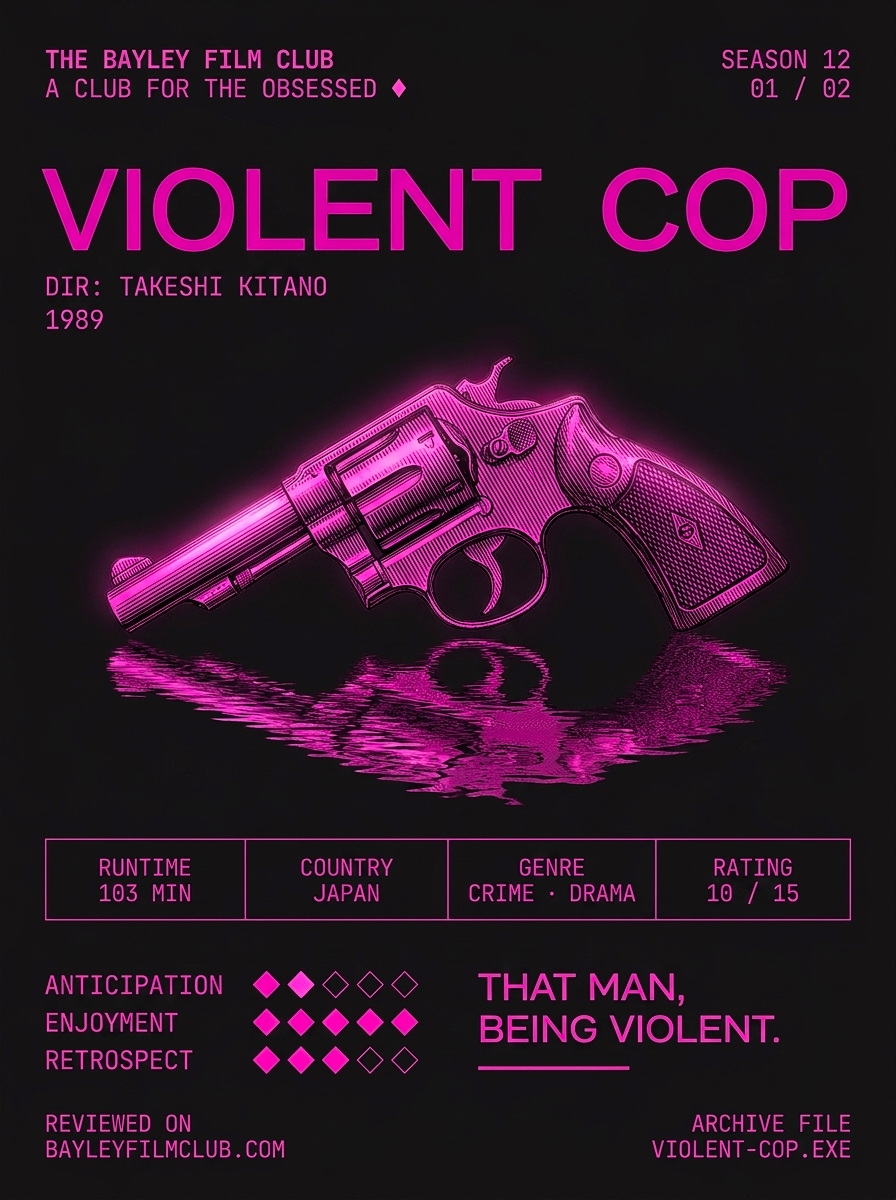
Violent Cop — translated literally as "That man, being violent" — is the directorial debut of Takeshi Kitano, who also plays the main role. Released in 1989, it shows a rather interesting picture of Japan in the eighties. It was originally supposed to be a comedy. The decision to change the narrative was taken by Kitano himself. That decision turned out to be the right one.
The film is a police drama, though it still carries quite a bit of humour — distributed throughout via the sarcastic comments and deadpan delivery of Azuma (Kitano), whose ability to smile can be highly questioned. The creation of characters is amusing, and the script is sharp in ways that don't announce themselves.
The story itself can be summarised in a single sentence: we follow the investigation of Azuma into drug distribution and mafia business in the city. What I found far more interesting was the way everything was portrayed. Violent Cop has great camera work, beautiful perspectives, and a considered mix of long shots that slow the action right down, against brief and rapid cuts that are informative and of extreme importance to the plot.
The way the film is made brings to mind the true experience of police work — more filled with slow, consistent, and pragmatic events than with the occasional rapid action that passes immediately for everyone involved.
Exactly not like Hollywood has been picturing it — with a cop's life as an ongoing stream of exciting and adrenaline-pumping situations — Violent Cop gives us something more real and more interesting. The procedural rhythm of the film mirrors the actual rhythm of the work it depicts. That is a rare and undervalued quality in police cinema, and Kitano achieves it in his very first film as a director. Bravo for that.