What Is Hidden
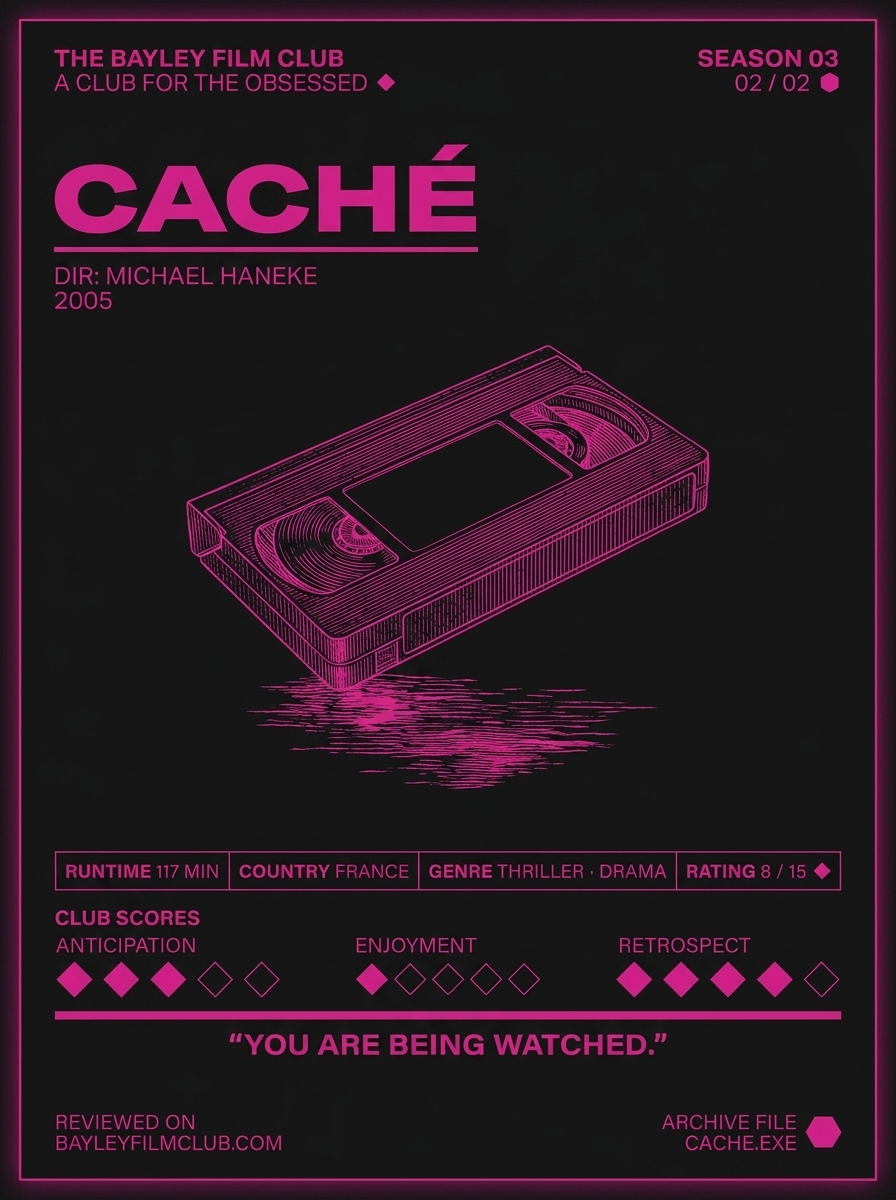
Michael Haneke is famous for creating films of a rather disturbing nature — work that seeks to make audiences question their own beliefs, their comforts, their complicity. Caché (2005) is perhaps his most insidious achievement in this regard. It focuses on how we take privacy for granted, on secrets, and finally on the hidden but wildly nurtured scars that the past leaves behind. Caché means exactly that — hidden.
The story develops slowly as the atmosphere becomes progressively darker. Haneke's approach is minimalistic — there is no score pushing you toward a reaction, no conventional thriller mechanics to grip — and yet the film captures that itchy part of the mind where a quiet voice whispers that you are being watched. It is a deeply uncomfortable feeling, and the film sustains it with remarkable discipline.
What is hidden, exactly? Is it the camera used to film the entrance of the main character's house, whose location is never revealed? Is it the identity of the person filming it? Haneke offers no clear answer to either question — and crucially, this is not a failure of resolution but the point entirely. The answers are not relevant. What matters is the feeling the film creates inside the viewer's head.
It is the motives of the people involved that are hidden. Caché illustrates the irrational behaviours that occur when our normal lives are disrupted.
In my reading, what the film ultimately conceals is motive — the interior lives of everyone on screen, including the protagonist, remain opaque in ways that feel deliberately unsettling. Haneke implicates not just his characters but the audience in the act of watching, of surveillance, of choosing what to notice and what to overlook. Caché illustrates the irrational behaviours that surface when our normal lives are disrupted, and asks quietly how normal those lives really were to begin with.