Somewhere In Between
A Perfect World was a revisit for me — a return to the Texas Ranger's reality seen through the eyes of Clint Eastwood. I first saw this film many years ago, but even then it made a strong impression on me, guaranteeing itself a safe place in my memory.
A Perfect World is the story of a convict — Butch Haynes (Kevin Costner) — who escapes prison and finds himself on the run with an eight-year-old hostage: Phillip, aka Buzz. The man builds a relationship with the boy, and the Haynes–Phillip dynamic becomes one of the film's central messages. Its importance grows even bigger when it is revealed that neither Butch nor Buzz had a father figure present in their life.
At first we have the impression that Phillip is blindly following Haynes, impressed by his masculinity, his intelligence, and his morals — questionable in terms of the law, but mostly reasonable.
Little Phillip, though shy and quite reserved, has a very good understanding of good and bad — and manages to make a difficult decision in the moment it matters most. Something many grown-ups would find difficult to do.
On the other end of the story we have Texas Ranger "Red" Garrett (Clint Eastwood), accompanied by the governor's assignee Sally Gerber (Laura Dern). Sally is the only woman involved in the pursuit, and she seems used to fighting for her position in a man's world. She quickly proves her worth when her modern forensic methods — built on psychology and on understanding the convict's motives — bring real value to the on-the-road investigation.
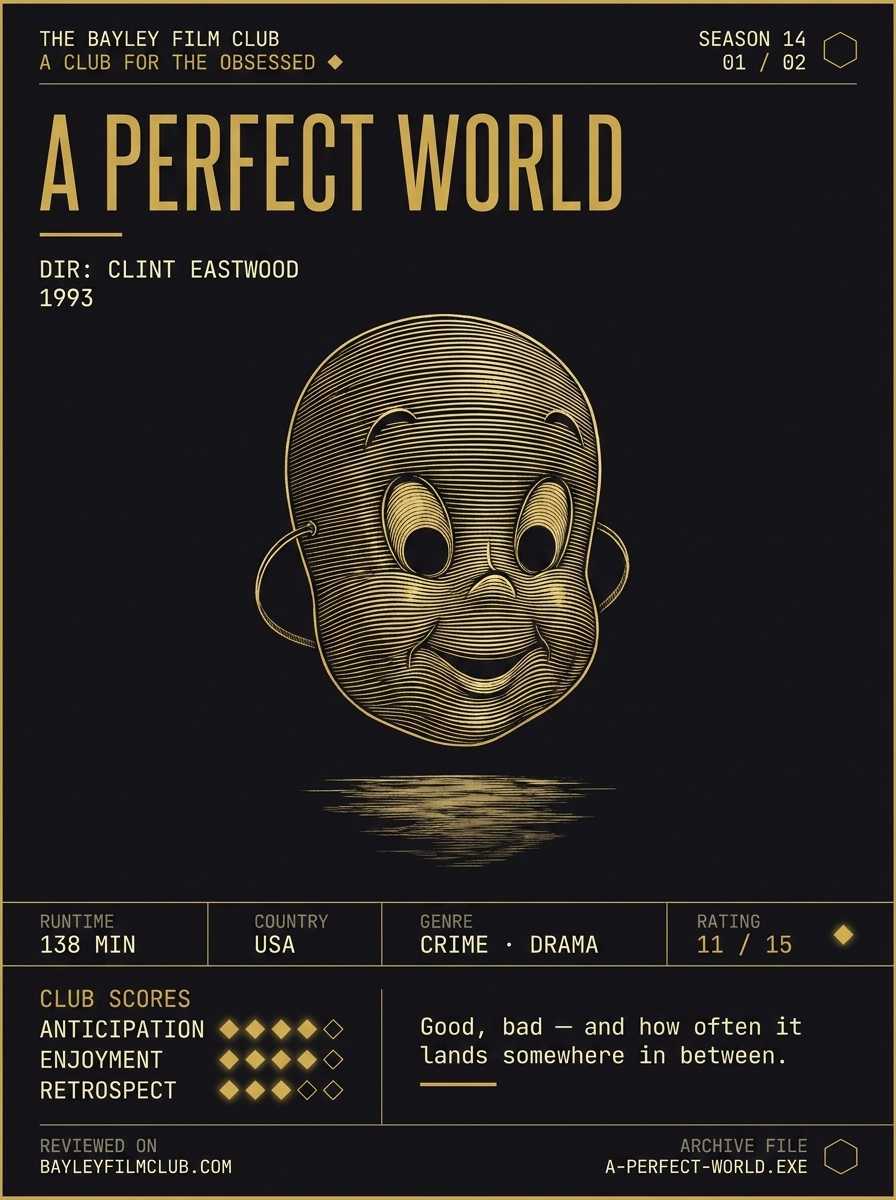
A Perfect World is a good picture, tackling questions about morality: what is good, what is bad, and how many times it is somewhere in between. Everything is always left to interpretation, and depending on who we ask — and what that person's biases are — we may end up with very different outcomes.
And that, in my view, is the message passed on by A Perfect World. One that applies well beyond the film.

As an Amazon Associate I earn from qualifying purchases.